Chicago, Illinois
An Afternoon in Pilsen: Chicago’s Murals, Mexican Art, and Food
Begin at the National Museum of Mexican Art, follow a few nearby murals and make time for a meal on 18th Street. A compact route with the neighborhood’s artists and institutions at its center.

A giant figure stretches across a house in Pilsen, caught in strands of painted barbed wire. A short walk away, a free museum tells Mexican and Mexican American stories through art. On 18th Street, a restaurant menu offers another set of regional connections. These are reasons to give this Chicago neighborhood an afternoon of its own. Start with the National Museum of Mexican Art, choose a handful of nearby murals and leave enough time to eat. The most interesting part is discovering who made these places, and what they are saying.
At a glance
- Start here
- National Museum of Mexican Art, 1852 W. 19th Street. Admission is free; normal hours are Tuesday–Sunday, 10 a.m.–5 p.m.
- The shape of the afternoon
- Our suggestion: about four hours for the museum, a compact mural loop and one meal. Extend it for a guided tour or a scheduled event.
- Research checked
- October 16–17, 2026. The Pink Line currently uses a Racine/Blue Line transfer for downtown journeys; see the transport section.
Give the museum the first word
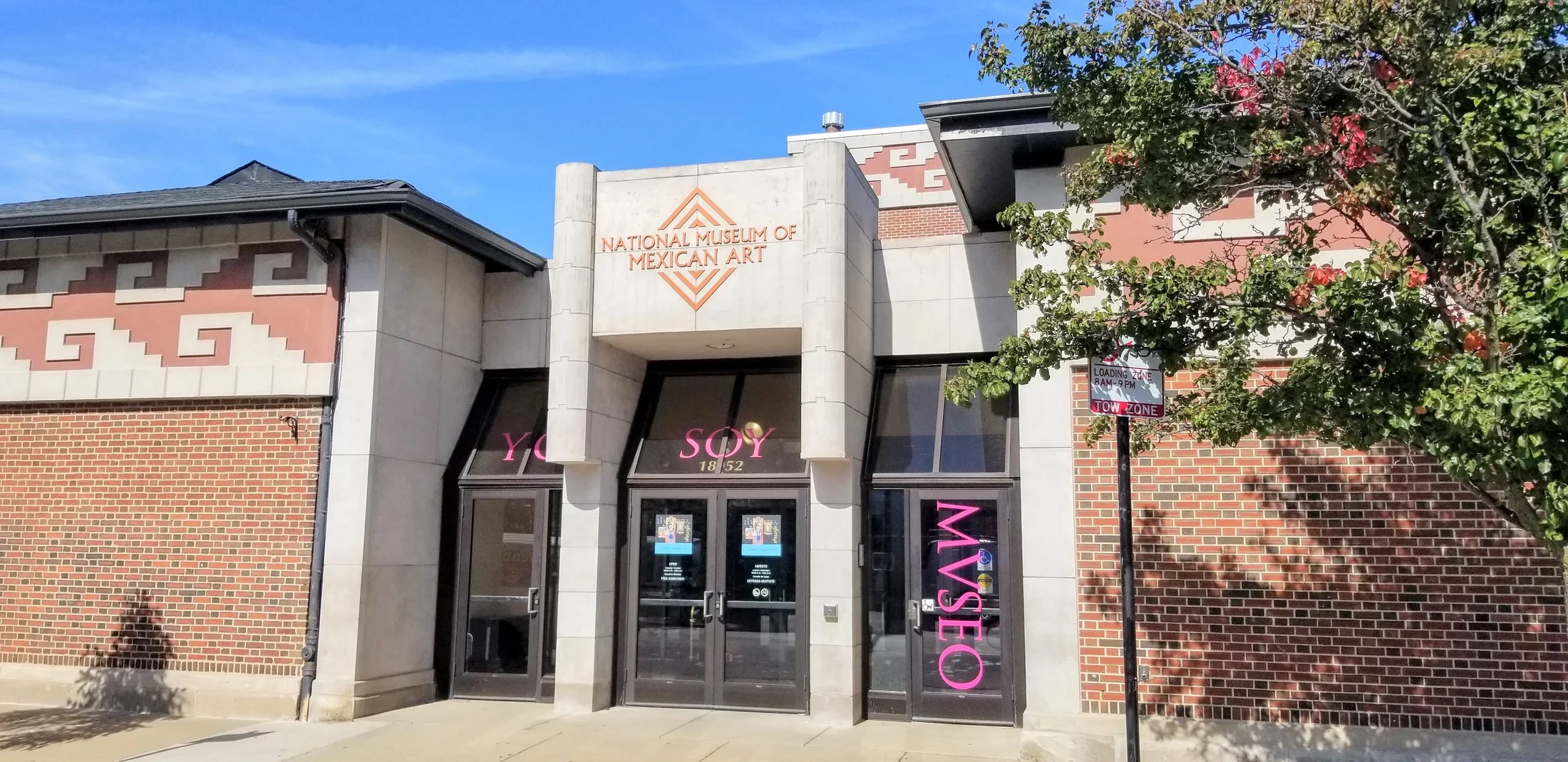
Begin at the National Museum of Mexican Art on the south side of Harrison Park. Its location matters. This is an institution rooted in the community around it, with a collection and educational mission that reach across the United States–Mexico border.
Carlos Tortolero and fellow educators founded the organization in 1982; the museum opened in 1987. Its history describes a desire to create a place where Mexican and Mexican American communities could present their own culture and where art would be accessible to people who were often underserved by major institutions. Free admission is part of that purpose.
The building has a neighborhood history of its own. The Chicago Park District records that the museum occupies a former natatorium, built as part of the park’s early recreation facilities. A building once devoted to swimming became a place for art. Outside, Harrison Park continues to support sports, play and other everyday activities.
Starting here changes the way the afternoon unfolds. Instead of arriving with a list of walls to photograph, you begin with an institution that helps explain why images matter in this neighborhood. Allow at least an hour, as the museum recommends, and more if an exhibition draws you in. There is no advantage to leaving a good gallery encounter unfinished just to keep an arbitrary mural schedule.
Look for more than one version of Mexican identity
Nuestras Historias, the museum’s permanent-collection exhibition, brings together work from different periods, regions and communities. Its curatorial approach treats identity as something that develops and changes, rather than a single story that can be represented by one artist or one kind of object.
That makes it a useful starting point even if Mexican art is unfamiliar to you. Move between works and notice what changes: material, scale, setting, the people represented, or the way an artist addresses the viewer. Ancient and colonial objects, modern work, folk art and contemporary practice can lead to quite different conversations. The museum’s own exhibition text deliberately resists arranging all of that diversity into one simple line.
Our suggestion is to choose two works to spend time with. Read their labels, look again, and consider what the label helped you see. This is a more useful preparation for the streets outside than trying to remember every name. Individual objects and temporary exhibitions can change, so use the current gallery information rather than expecting a particular online collection image to be on display.
Then carry a question outdoors. Who is speaking in an image? Who is being remembered? Is the work celebrating something, making an argument, or leaving an uncertainty unresolved? Those questions will serve you well at a mural, where there may be no wall label to do the explaining.
Pilsen’s walls belong to a living neighborhood
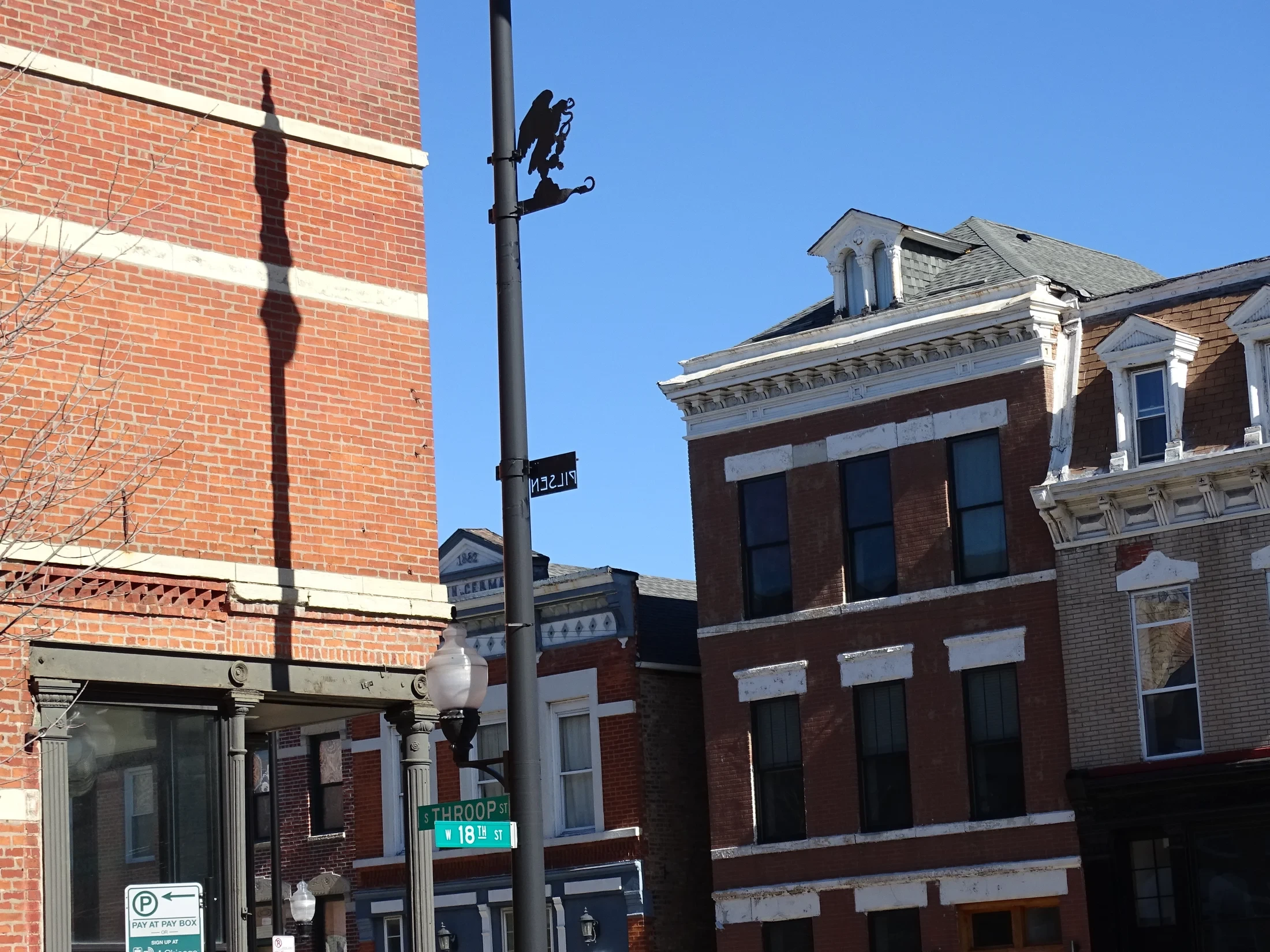
Pilsen has been shaped by several generations of migration. The museum’s neighborhood-history exhibition and Chicago History Museum’s educational materials describe a working-class area with Czech, Polish and other European immigrant communities, followed by a strong Mexican and Mexican American presence. The neighborhood’s story is more complicated than a change of restaurant signs.
Its murals express that complexity. They address identity, work, migration, pride and struggles over who can remain in a place. Notre Dame’s Latinx Murals of Pilsen project treats public art as a way to study belonging and displacement, as well as artistic form. That is a useful lens for a visitor: an image on a house or a station wall can participate in a local conversation that began long before your arrival.
The organizations sustaining those conversations matter, too. Yollocalli Arts Reach, the museum’s youth initiative, has offered free arts and culture programs since 1997. Pilsen Arts & Community House provides exhibitions, instruction and mentorship. Art here is also something people learn, teach and make together.
This is why the route below stays relatively small. A few works with their artists’ names attached can tell you more than a long roll of unidentified photographs. Let the museum’s downloadable guides supply background, and leave room to notice the ordinary life around the art: school trips, neighborhood errands, a restaurant preparing for service.
.jpg)
Across from the museum, meet the next generation of mural makers
Before leaving the museum area, look for La Estampida de Valientes on the museum’s Casita at 1859 W. 19th Street. The museum’s Yollocalli guide credits Mario Mena and young artists from the program with the 2023 work, created through a partnership with the Chicago Bulls.
The imagery mixes basketball and Mexican cultural references: running bulls transform into a winged animal, while basketballs appear within marigold forms. The museum’s explanation connects the composition with a nahual, a spiritual animal form, and with the feathered-serpent imagery on another side of the building. It rewards looking for how the parts relate, rather than identifying the sports logo and moving on.
Keep the youth collaborators in the story. A mural may have a lead artist, but the work of learning, planning and painting can involve many people. Yollocalli’s guide documents collaborations across Pilsen, including works farther east and south than this short afternoon needs to cover.
Use the guide to choose an extension if public art becomes the main focus of your day. For this route, the Casita is enough to introduce a contemporary, collaborative work before moving on to a very different image nearby. Street art can be altered, covered or restored over time; ask the museum about current local conditions when you visit.
At Gulliver, let the image stay complicated
Continue toward 1900 W. Cullerton Street to see Héctor Duarte’s Gulliver in Wonderland, also known as Gulliver en el País de las Maravillas. Created in 2005 on the exterior of his home and studio, the work turns a familiar literary image into a meditation on migration.
The giant figure is bound with barbed wire. In an interview preserved by Notre Dame’s Pilsen project, Duarte explains that the wire evokes the border and that the figure can be seen as falling backward or trying to rise. The uncertainty matters. Work, acceptance and the possibility of finding a place in society are part of his account of the image.
Take time to read the scale of the painting against the building. The figure exceeds the usual frame of a picture and becomes part of the street. The museum’s mural guide adds further context and identifies the work’s address; it is a helpful companion if you want to look closely at particular details.
This is also a home and studio. View the exterior from public space, keep entrances clear and treat any interior visit as a separate arrangement. Nothing about a mural on a building establishes open studio hours.
From here, return toward Wood Street and 18th Street for food. If you want another nearby work, the museum guide identifies Alejandro Medina’s All About the Women at 1757 W. 18th Street, with portraits of significant women and references to Michoacán. It fits this compact route without requiring a detour across the neighborhood.
Choose a meal that fits the afternoon
There are two useful food options close to this route, and they suit different plans. Choose one as your main meal rather than treating lunch as a contest to sample the most restaurants.
For a seated break, consider 5 Rabanitos at 1758 W. 18th Street, at Wood. Chef Alfonso Sotelo’s restaurant describes a menu drawing on several Mexican regions. The Pilsen menu includes chicken enchiladas with red mole, achiote-marinated cochinita pibil and roasted-vegetable tacos, among other choices. The range makes it a useful option when your group wants a choice of dishes rather than one specialty.
Reserve if you want a fixed meal time, selecting the Pilsen location rather than the separate Hyde Park restaurant. Check the current menu and discuss dietary requirements directly with staff; the presence of a vegetable dish does not establish how every ingredient is prepared. A seated meal here works well after the museum and nearby murals, particularly if the weather has made an outdoor break less appealing.
Carnitas Uruapan at 1725 W. 18th Street is a different proposition. Founded by Inocencio Carbajal in 1975, the business centers its story on carnitas and its Michoacán roots. Its menu offers pork carnitas by the taco or pound. Crucially, the Pilsen branch currently lists takeout only; descriptions of seating at its other locations should not shape your plan here.
It also closes earlier than an evening restaurant: the published hours end at 4 p.m. Monday–Friday and 5 p.m. Saturday–Sunday. If this is your choice, make it an earlier stop and decide where you will eat before ordering. Keep food outside the museum galleries and take your packaging with you.
Let 18th Street bring the route back to everyday life
As you return along 18th Street, the neighborhood’s art and commercial life come together. The route connects a museum, artists’ work and food businesses without requiring a trip to another part of Chicago. That proximity is its strength; there is no need to fill every remaining minute with a new attraction.
If you are taking the Pink Line, the 18th station at 1710 W. 18th Street offers another encounter with public art. CTA credits Francisco Mendoza, Gallery 37 students and the museum for the station’s 1998 painted murals, which depict Mexican heritage and cultural figures. Remember that this is a working station. Keep paths clear, follow normal fare requirements and allow riders to move through.
The art has a history of care as well as creation. CTA reports that repairs approved by Mendoza’s family were completed by muralist Roberto Valadez in 2021. That detail is worth carrying into the visit: a public image lasts because people continue making decisions about it.
For a longer afternoon, consult the museum’s mural maps before setting out farther east or north toward the 16th Street corridor. A guided walk may be a better extension if you want more history and conversation. Check a current local tour listing, its meeting point and the walking commitment rather than assuming a past event remains bookable.
Use the calendar to choose your version of Pilsen
The museum normally opens Tuesday–Sunday from 10 a.m. to 5 p.m., with extended hours until 8 p.m. on the first Wednesday of each month. Mondays and certain holidays are closed. Its galleries and shop are on the main floor, and accessibility information includes an entrance ramp, loan wheelchairs and cane stools, sensory bags and selected visual descriptions. Contact the museum about specific needs or equipment availability.
If your trip falls in late October 2026, the neighborhood offers reasons to change this ordinary-afternoon plan. The museum’s free Día de los Muertos Xicágo event is scheduled for October 24, with community ofrendas, performances and activities. It is a gathering to remember departed loved ones; approach it with the attention that purpose deserves.
Pilsen Arts & Community House also lists 18th Street Pilsen Open Studios for October 24–25, noon–6 p.m., with free mural walks at 11 a.m. on those days requiring registration. Use the organizers’ current maps and listings to see what is open. A studio participating in that weekend should not be assumed to welcome drop-in visits on any other date.
On an ordinary day, support the places you actually spend time with: buy a meal, browse the museum shop, purchase work that interests you or join a properly booked local tour. Ask before making an identifiable person the subject of a photograph, and give residents the same space you would want outside your own front door.
.jpg)
Get there with the current train route in hand
The museum identifies the Pink Line’s Damen and 18th stations as useful arrival points, alongside the 50 Damen and 9 Ashland buses. CTA lists both stations as accessible, but check elevator alerts and the route from your starting point before traveling. The museum’s address is 1852 W. 19th Street; Harrison Park’s fieldhouse has a different address.
There is a specific short-term complication at the time of this research. From October 13 through October 25, 2026, Lake Street Bridge work diverts Pink Line trains to Racine on the Blue Line. For a downtown journey, CTA directs riders to make a free same-platform transfer there. The project is scheduled to finish at 4 a.m. October 26. Additional Loop elevated service suspensions are listed for October 24–26, so check the dated alert for the day you travel. The usual one-seat Pink Line route around the Loop is not the current plan during this work.
Once in Pilsen, keep the afternoon flexible: museum, Casita mural, Gulliver, then a meal and the return toward 18th Street. Move the meal earlier for Carnitas Uruapan or give more time to a temporary exhibition. About four hours is our suggested allowance, not a guaranteed duration or a requirement to walk at a particular pace.
The afternoon works when it leaves you with a few names and stories you did not have before: the educators who started the museum, the young people painting with Yollocalli, the artist who turned Gulliver toward Chicago. Those connections give the neighborhood’s color its depth.
The details
A few good questions.
Is the National Museum of Mexican Art free?
Yes. General admission is free. Normal hours are Tuesday–Sunday, 10 a.m.–5 p.m., with first-Wednesday evening hours; check holidays and special events for your date.
Can I see Pilsen’s murals without taking a tour?
Yes. The museum provides two downloadable guides with artist names, background and maps. View exterior works from public space and treat any studio entry as a separate arrangement.
Is this a good Monday itinerary?
The museum is normally closed Mondays, so choose another day for the full plan. An outdoor walk and meal can still be possible, but check each business and any event separately.
Where can I sit down to eat on this route?
5 Rabanitos at 1758 W. 18th Street is the seated-meal option discussed here. Carnitas Uruapan’s nearby Pilsen location currently lists takeout only, unlike some of its other branches.
Can I combine Pilsen with the Riverwalk in one day?
You can, but we suggest giving each a separate half-day and checking current transit. Combining the full Pilsen plan with a river cruise, museums and a long downtown walk makes a crowded day.
Behind the story
Sources & further reading.35 sources behind this story
Research reviewed October 17, 2026. Check the linked providers for updates before travel.
Researched and written with AI, with automated editorial review. Read how we check our stories.
- Current rail service alerts | CTAChecked 2026-10-17
- Lake Street Bridge work and train diversions | CTAChecked 2026-10-17
- National Museum of Mexican Art: plan your visitChecked 2026-10-17
- National Museum of Mexican Art: history and missionChecked 2026-10-16
- National Museum of Mexican Art: accessibilityChecked 2026-10-16
- Nuestras Historias | National Museum of Mexican ArtChecked 2026-10-16
- Día de los Muertos Xicágo 2026Checked 2026-10-17
- Pilsen / Little Village: archival exhibition | NMMAChecked 2026-10-16
- Yollocalli Arts Reach: youth arts programsChecked 2026-10-16
- Gulliver in Wonderland | Notre Dame Pilsen projectChecked 2026-10-16
- Héctor Duarte interview | Notre Dame HUEChecked 2026-10-16
- Latinx Murals of Pilsen | University of Notre DameChecked 2026-10-16
- Public art at 18th station | CTAChecked 2026-10-16
- 18th station mural preservation | CTAChecked 2026-10-16
- 18th station: access and service | CTAChecked 2026-10-16
- Damen Pink Line station | CTAChecked 2026-10-16
- Pink Line (Route info, alerts & schedules) - CTAChecked 2026-10-16
- Harrison (Carter) ParkChecked 2026-10-16
- Authentic Mexican Restaurant in Pilsen | 5 RabanitosChecked 2026-10-16
- Carnitas Uruapan: locations and hoursChecked 2026-10-17
- Our story – Carnitas UruapanChecked 2026-10-16
- Pilsen Arts & Community HouseChecked 2026-10-17
- About — Pilsen Arts & Community HouseChecked 2026-10-16
- CHM at Home Teens: Pilsen - Chicago History MuseumChecked 2026-10-16
- Walking Tour | Pilsen Murals - Chicago History MuseumChecked 2026-10-16
- Pilsen | Chicago Neighborhoods | Choose ChicagoChecked 2026-10-16
- National Museum of Mexican Art: A Guide to Pilsen’s MuralsChecked 2026-10-16
- National Museum of Mexican Art: A Guide to Yollocalli’s Murals in PilsenChecked 2026-10-16
- National Museum of Mexican Art entrance.jpg — photograph and licenseChecked 2026-10-16
- Photograph license: CC BY-SA 4.0Checked 2026-10-16
- Street Scene - Pilsen - Chicago - Illinois - USA - 03 (32978706065).jpg — photograph and licenseChecked 2026-10-16
- Photograph license: CC BY-SA 2.0Checked 2026-10-16
- After The Storm (391807998).jpg — photograph and licenseChecked 2026-10-16
Your next somewhere.
U.S. travel stories with sources you can follow and places worth making time for.
Our editorial approachExplore destinationsShare a little inspiration