Prescott, Arizona
Prescott in Two Days: Granite Lakes, Pine Woods and Living History
Pair Watson Lake’s granite scenery with a forest morning and two very different museums. This two-day plan leaves time to linger—and explains which paths and schedules fit your trip.
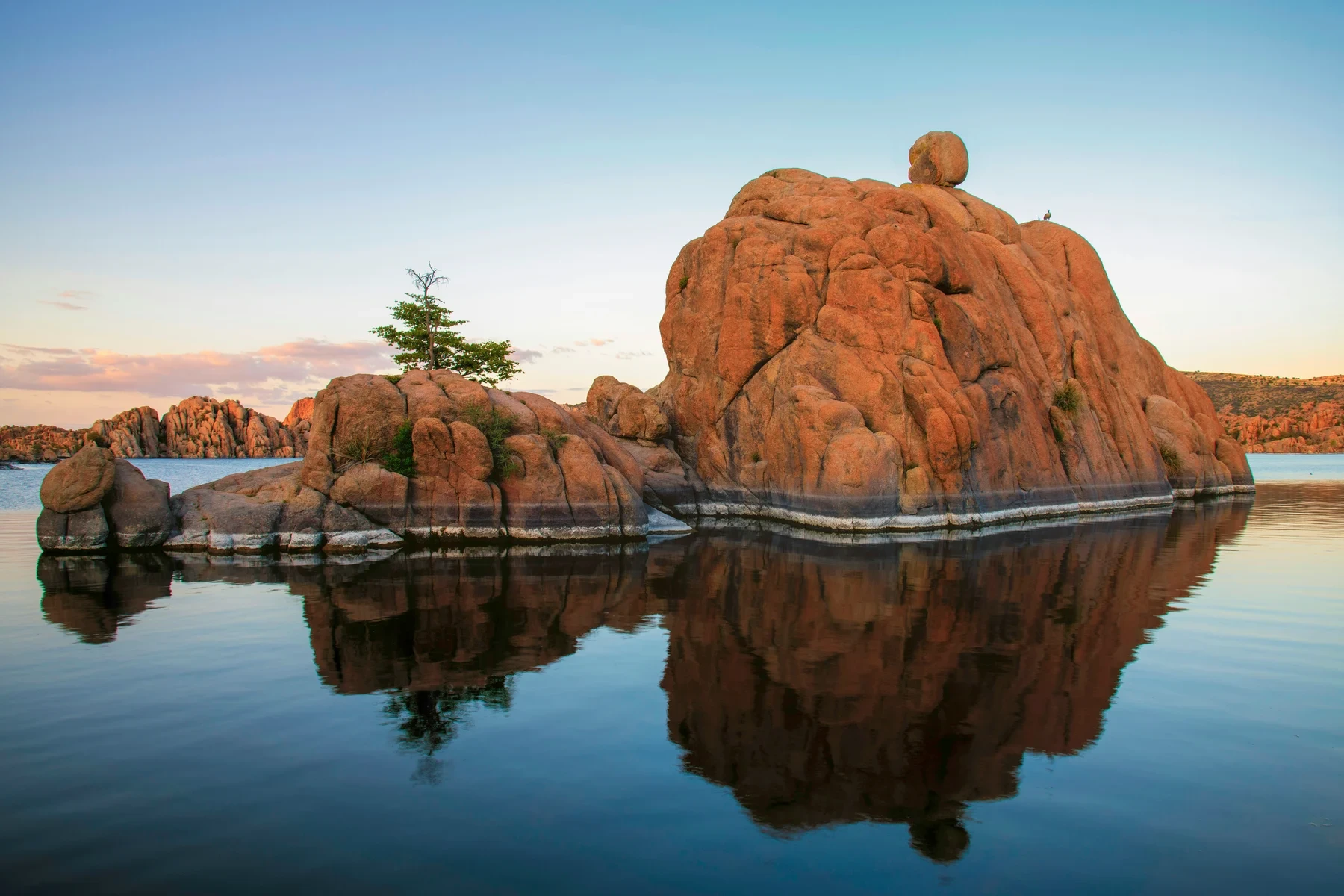
At Watson Lake, granite rises straight out of the water. South of Prescott, Goldwater’s shore trades those open rock formations for pines. Between them is a downtown where a museum visit can change the way you read the buildings around the courthouse. You can enjoy all three sides of Prescott in a weekend without spending both days chasing trail mileage. Use this as a Saturday-and-Sunday plan, with a choice of outdoor routes rather than a requirement to complete every stop. Visitor rules, fees and schedules were checked October 21, 2026. One important change: Sharlot Hall Museum’s Governor’s Mansion is closed for rehabilitation, with reopening expected in early 2027; the wider museum still offers plenty to explore.
At a glance
- Weekend order
- Saturday: Watson or Peavine, Museum of Indigenous People, downtown. Sunday: Goldwater or Highlands Center, then Sharlot Hall.
- Important closure
- Sharlot Hall’s Governor’s Mansion is closed for rehabilitation; reopening is expected in early 2027.
- Water access
- Swimming is prohibited at Watson, Willow and both Goldwater lakes. Lower Goldwater also prohibits watercraft.
- Seasonal gate change
- Municipal lake hours change November 1 from 6 a.m.–10 p.m. to 7 a.m.–6 p.m.; check your date.
Build the weekend around two mornings outdoors
Give Saturday morning to the Granite Dells, then visit the Museum of Indigenous People before a downtown evening. On Sunday, choose Goldwater Lake for a picnic among pines or the Highlands Center for an interpretive garden and a shorter forest walk. Sharlot Hall Museum opens at noon on Sunday, making it a natural final stop before you leave.
The order matters. The Museum of Indigenous People closes Sundays, while Sharlot Hall closes Mondays. Switching the days casually can remove the very visit you wanted. Arriving Friday evening gives you the most breathing room, but a Saturday arrival still works: shorten the lake outing and protect the museum’s afternoon opening window.
This plan assumes a car for the lakes and forest stops. Downtown makes a useful walking base for meals and browsing, but the outlying places are separate destinations. Staying near the courthouse simplifies your evenings; staying farther out may suit your room or parking needs, with an extra drive into town. Compare the actual lodging location rather than relying on a Prescott mailing address.
For travelers coming from Phoenix, check the route from your own starting point and leave margin for traffic. A tourism brochure’s broad drive-time estimate is not a reliable appointment time. The suggested blocks here are deliberately generous: one outdoor experience and one cultural visit per day, with lunch between them.
Saturday morning: see Watson Lake without committing to its loop
Watson Lake is the dramatic opening: rounded granite masses, water threading between them, and broad views that make a picnic feel like an event. The city park is about four miles from downtown, reached from Highway 89 at 3101 Watson Lake Park Road. Start here if your main goal is to see the landscape and spend time by the water.
The park has picnic facilities, restrooms, two boat launches and hiking trails. Arizona’s tourism office identifies a covered ramada by the parking area overlooking the landscape. That gives you a useful first destination before deciding how far to walk. Look at the ground and your group’s energy, then choose a route; seeing the lake does not require circling it.
The full Watson Lake Loop is a different undertaking. The state tourism description calls it a nearly five-mile route involving clambering over boulders. A lake loop can sound like a gentle promenade on a map, but this one should not be your default if you want a short, predictable walk. Use the city’s trail maps to distinguish the rocky shoreline routes from the nearby former railway corridor.
Boating is another way to spend the morning. Born To Be Wild Adventures advertises year-round rentals, weather permitting; check the actual date, lake and meeting arrangements before building a plan around a boat. The operator supplies life jackets and asks visitors to bring water, sun protection and suitable clothing. Swimming is prohibited at Watson Lake. A boat rental and a swim stop are different activities here.
For an unhurried weekend, choose either a modest walk or a booked paddle as the main morning activity. Leave enough time to return to town, eat lunch and reach the museum without watching the clock through every exhibit.
For a steadier walk, use the Peavine—and notice the preserve boundary
The Peavine follows a former railway corridor past Watson Lake and into the Granite Dells. Its relatively level alignment offers a different experience from scrambling around the shoreline. Arizona Highways describes a six-mile round trip to the junction with the Iron King Trail; that is a particular outing, not a requirement or a statement of the entire trail’s length.
For this weekend, an out-and-back with a turnaround chosen to suit your group is more useful than a mileage target. Begin from the Sundog Ranch Road trailhead and check the map before setting off. The Peavine and Watson Woods share parking; this is a different entrance from the main Watson Lake park off Highway 89. Prescott Creeks gives the preserve access address as 1626 Sundog Ranch Road.
The rail history helps explain the walking. Trains used the Santa Fe, Prescott and Phoenix route from 1893 until 1984; today walkers share the corridor with cyclists and horses. Relatively level still does not mean paved throughout, shaded throughout or suitable for every mobility device. Prescott Creeks describes the short paved entrance giving way to cindered trail. Ask the city about current surfaces if those details determine whether you can use it.
Watson Woods is an optional detour for a different kind of attention. The 126-acre preserve protects a remnant cottonwood-and-willow forest along Granite Creek. Its story includes damaged habitat and restoration work, including a major project carried out from 2009 to 2013. Go to observe the creekside environment, with no promise that a particular bird will appear.
The preserve has its own rules: daylight access, designated paths, no use of wet or muddy trails, and no dogs, bicycles or horses. A $2 visitor donation is requested. Those restrictions do not disappear because the entrance shares a lot with a multi-use trail. If you have a dog or bike, remain on routes that permit it instead of treating the preserve as a convenient continuation.
Saturday afternoon: make room for living Indigenous culture
Put the Museum of Indigenous People at the center of the afternoon, rather than squeezing it into the final minutes before closing. At 147 North Arizona Avenue, it opens Monday through Saturday from 10 a.m. to 4 p.m. and is closed Sunday. General adult admission is $10; the museum encourages arrival at least an hour before closing. Aim for around 1:30 or 2 p.m. if your morning allows.
Its purpose is broader than displaying objects from the past. The museum describes Indigenous knowledge, artistry, history and contemporary experience together, with Native staff, advisors, artists and community partners helping shape interpretation. Its featured Contributions exhibition examines subjects such as agriculture, technology and water systems. Check the current exhibition list for your dates rather than expecting a particular temporary display to remain indefinitely.
The institution also addresses its own difficult history. It grew out of a non-Native civic organization that staged fabricated versions of Native ceremonies; its account recognizes Native criticism and the final performance in 1990. The museum adopted its current name in 2020. Reading that history alongside the collections makes this a more thoughtful stop than an uncomplicated celebration of an imagined Old West.
Accessible parking and an entrance are behind the building. Contact the museum about the arrangements you need, and check holiday or event changes before traveling. Keeping this visit on Saturday is the single most useful scheduling decision in the weekend.
Spend the evening around Courthouse Plaza, with time to look
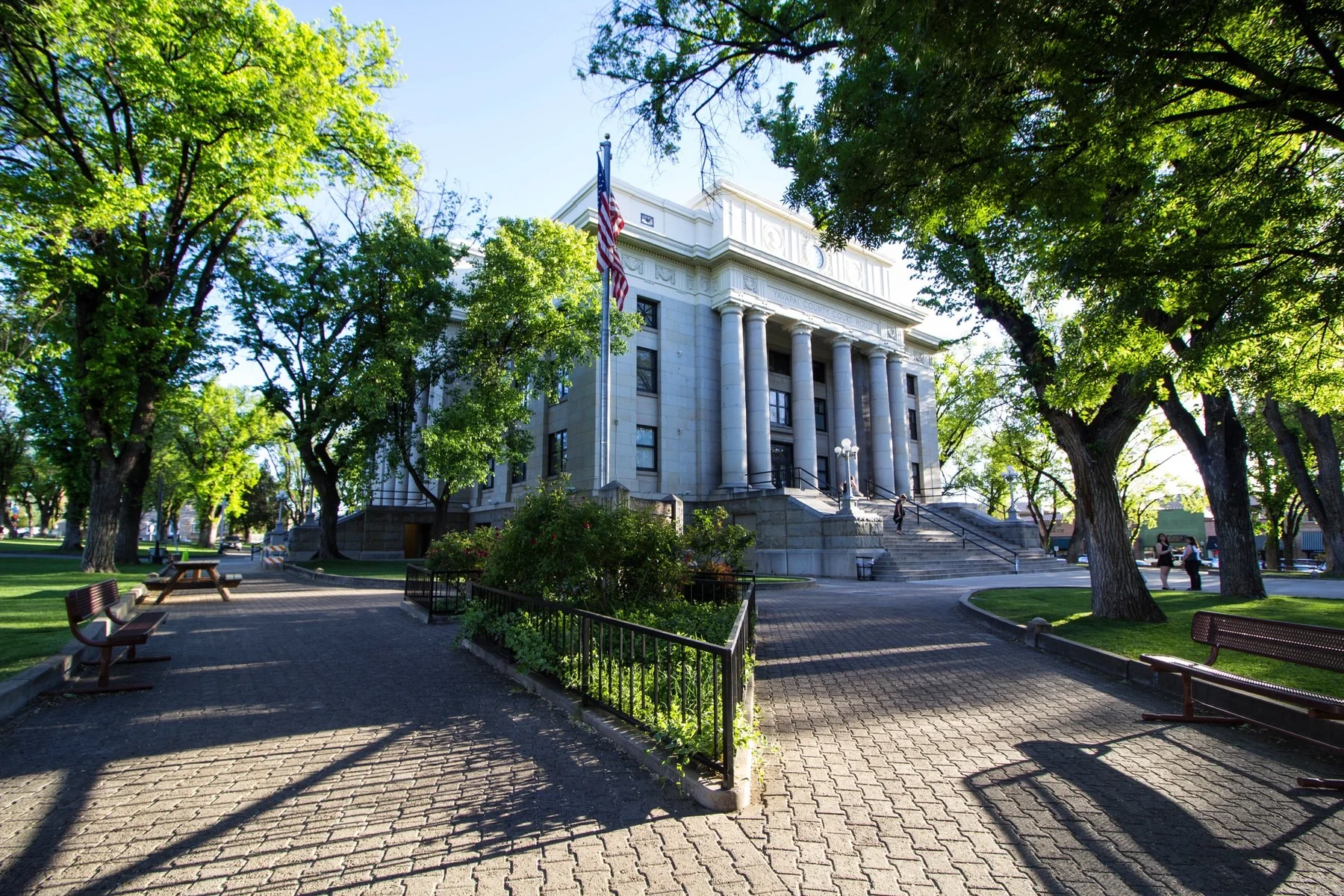
Return to the courthouse area for dinner and an unhurried circuit of the surrounding streets. Whiskey Row can be part of that evening, but it need not dictate it. Galleries, storefronts and the plaza give you a compact place to browse before choosing a table. Leave the meal flexible unless a particular restaurant is the reason for your trip.
The history you have just encountered gives the streets more depth. Prescott became Arizona’s first territorial capital in 1864, lost that role to Tucson, regained it, and eventually yielded it to Phoenix in 1889. That government-and-settlement story unfolded on Yavapai homelands. The Yavapai-Prescott Indian Tribe’s own history records the reservation’s establishment in 1935 and later expansion; its community is part of the region’s present, not only its museum past.
The city’s tourism office describes free on-street downtown parking and a garage about a block from the plaza, with exceptions for certain holidays and events. Read the signs and time limits at the place you actually park. A recreation-area pass is a separate question from downtown parking.
If you want another short walk, the downtown Greenways follow parts of Miller and Granite creeks, with city-listed access at Sheldon and Montezuma. Treat this as an optional look at the creek corridor, using the current map and signs. The city page discusses a developing network; it does not justify promising a finished, continuous three-mile loop.

Sunday option one: Goldwater Lake for a picnic in the pines
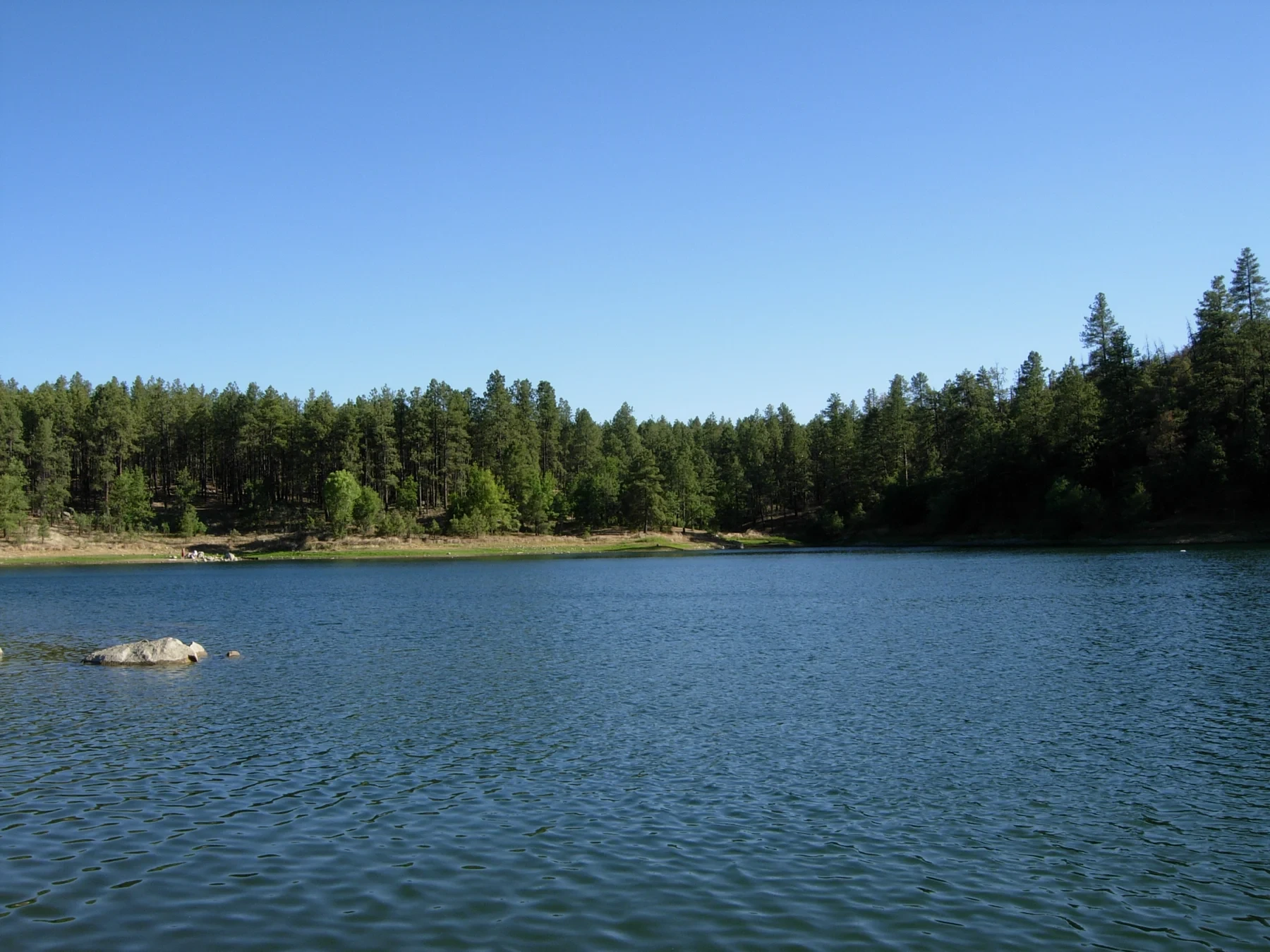
Goldwater changes the texture of the weekend. Instead of spending another morning among exposed granite, head south of downtown to the forested lake setting at 2900 South Goldwater Lake Road. The city describes it as about a four-mile drive from Prescott. Bring breakfast or picnic supplies and give the shore some time before deciding whether to walk farther.
Upper Goldwater has picnic tables, ramadas, restrooms, a playground and a boat launch. The city identifies accessible picnic sites, but that should not be stretched into a promise that every shoreline path is accessible. A table, a view and a short walk that you can comfortably retrace make a complete outing. Trails connect into the surrounding national forest, so check a map before following an appealing path away from the lake.
Upper and Lower Goldwater have different rules. Upper allows boats with electric motors and offers canoeing and kayaking; gasoline motors are not allowed. Lower prohibits watercraft, including kayaks and paddleboards. Its fishing is catch-and-release, with artificial flies or lures only and no bait. Check the current fishing rules and license requirements if fishing is part of your plan. Neither lake permits swimming.
Choose this morning when your group wants a picnic, a playground or a reserved paddle with fewer interpretive stops. It pairs naturally with a noon-or-later museum visit back in town. You do not need to add Willow Lake as well: Willow is another granite-and-water alternative with its own launch and trails, but a third lake can turn a varied weekend into repeated loading and unloading of the car.

Sunday option two: a forest classroom at the Highlands Center
If the group wants to understand the landscape—or needs a more predictable walking surface—substitute the Highlands Center for Natural History for Goldwater. Its address is 1375 South Walker Road. This is a separate outing, not an extra stop that must be fitted into the same morning.
The James Family Discovery Gardens use an accessible paver pathway, learning circles and places to sit. The subjects move from native habitats to rainwater harvesting and the relationships between people and plants. A forest play area gives children something to do beyond following an adult’s pace. The center’s history in outdoor education helps explain why the grounds feel like a place to investigate rather than a garden to hurry through.
Keep the three walking choices distinct. The garden path is paved. The Stretch-Pebble Loop is a three-quarter-mile gravel nature trail that the center describes as wide, flat and accessible to many. The Highlands Trail is a 1.5-mile loop with moderate inclines. Those descriptions are more useful than calling the whole campus an easy hike; choose the surface and effort that suit your party, and check conditions directly when access is essential.
In October through March, the trails and gardens list daily hours of 8 a.m.–6 p.m., with no admission or parking charge. The nature store has a separate Tuesday–Saturday schedule, so do not rely on shopping there on Sunday. Leashed dogs are welcome on the trails but are excluded from the Discovery Gardens. Organized groups of ten or more must make arrangements in advance.
Sunday afternoon: Sharlot Hall, with the closure in mind
Sharlot Hall Museum at 415 West Gurley Street is a campus to explore, not a single room to check off. Historic buildings, exhibit spaces and gardens spread across four acres. Hall began restoring the territorial governor’s residence in 1927, and her museum opened in 1928; the institution grew from that effort to preserve the region’s history.
For an October-through-April weekend, Sunday hours are noon–4 p.m. General adult admission is $17 and is valid for two consecutive days. If Sharlot Hall is your main interest, you could start on Saturday and return Sunday, shortening another stop accordingly. There is no need to force both museums into one afternoon simply because the ticket permits a return.
The Governor’s Mansion is currently closed for rehabilitation, with reopening expected in early 2027. Treat that as an estimate and recheck before a future trip. Do not book a weekend around going inside it now. Instead, look at the museum’s current exhibit map: the Transportation Building’s vehicles and The Baskets Keep Talking, which presents Yavapai history, offer different ways into the collection.
The museum acknowledges that it operates on the ancestral land of the Yavapai-Prescott Indian Tribe. Read that alongside the territorial exhibits and Saturday’s visit. The reward is a fuller account of Prescott than a sequence of famous names and old buildings.
Allow time to move between exhibits, pause in the gardens and decide what interests you. Holiday closures and the separate hours of the research center, store and Fort Whipple location need their own checks. This plan uses the main Gurley Street campus; it does not assume every associated site is open on Sunday.
Set the practical limits before you leave
The city currently charges $5 per vehicle for day parking at Watson, Willow, Goldwater, Peavine and Constellation recreation areas; Wednesdays are free. At the municipal lakes, listed summer hours run April 1–October 31, 6 a.m.–10 p.m., changing November 1 to 7 a.m.–6 p.m. That seasonal shift matters if you plan a late afternoon at the water. Confirm the gate time for the specific place you choose.
A simple planning allowance for one adult is $27 for the two museums, plus food, lodging, transport and any recreation parking or rental you use. That is arithmetic from the checked general admission prices, not a package price. Do not assume a ticket bought at one lake transfers to another; check the kiosk or ask the city. Paying at the kiosk also avoids relying on an online annual-pass code that may not activate until the next business day.
Check the weather and current route information before committing to outdoor plans. Bring water and sun protection, and allow the forecast to change your choices. A poor morning for a paddle can become a shorter outdoor stop and a longer museum visit. If preserve trails are muddy, its manager asks you to stay off them.
The successful version of this weekend is not the one with the most pins on a map. It is the one where you remember the shape of the granite, something you learned about the people of this place, and a moment when you had nowhere else you needed to be.
The details
A few good questions.
Can I swim at Prescott’s lakes on this itinerary?
No. The city prohibits swimming at Watson, Willow, Upper Goldwater and Lower Goldwater. Boating rules also differ: Lower Goldwater does not permit watercraft.
Which walk has the most predictable surface?
The Highlands Center’s Discovery Gardens have a paved path. Its Stretch-Pebble Loop is a separate three-quarter-mile gravel trail. The Peavine is relatively level but not paved throughout; Watson Lake’s full loop involves rocky terrain.
Can I do this weekend without a car?
Downtown supports walking between meals, shops and the plaza, but this itinerary assumes a car for the lakes and Highlands Center. Arrange transport to each outlying destination before relying on the plan.
Is the Governor’s Mansion at Sharlot Hall open?
As checked October 21, 2026, it is closed for rehabilitation, with reopening expected in early 2027. The wider museum remains the planned afternoon visit; check the operator for changes.
Behind the story
Sources & further reading.31 sources behind this story
Research reviewed October 21, 2026. Check the linked providers for updates before travel.
Researched and written with AI, with automated editorial review. Read how we check our stories.
- City of Prescott — Watson LakeChecked 2026-10-21
- City of Prescott — municipal lake choicesChecked 2026-10-21
- City of Prescott — recreation parking passesChecked 2026-10-21
- City of Prescott — Upper and Lower Goldwater LakeChecked 2026-10-21
- City of Prescott — Willow LakeChecked 2026-10-21
- Experience Prescott — three-day itineraryChecked 2026-10-21
- City of Prescott — trail system and mapChecked 2026-10-21
- Sharlot Hall Museum — hours and admissionChecked 2026-10-21
- Sharlot Hall Museum — historic buildings and closureChecked 2026-10-21
- Sharlot Hall Museum — current and permanent exhibitsChecked 2026-10-21
- Sharlot Hall Museum — land acknowledgementChecked 2026-10-21
- Museum of Indigenous People — plan your visitChecked 2026-10-21
- Museum of Indigenous People — institutional historyChecked 2026-10-21
- Museum of Indigenous People — Contributions exhibitChecked 2026-10-21
- Highlands Center — James Family Discovery GardensChecked 2026-10-21
- Highlands Center — plan your visitChecked 2026-10-21
- Prescott Creeks — Watson Woods hours and guidelinesChecked 2026-10-21
- Prescott Creeks — Watson Woods directionsChecked 2026-10-21
- Prescott Creeks — restoration projectChecked 2026-10-21
- Highlands Center — trail surfaces and lengthsChecked 2026-10-21
- Arizona Highways — Peavine TrailChecked 2026-10-21
- Prescott Creeks — Watson Woods overviewChecked 2026-10-21
- Experience Prescott — transportationChecked 2026-10-21
- Arizona Office of Tourism — Watson Lake and Granite DellsChecked 2026-10-21
- Yavapai-Prescott Indian Tribe — tribal historyChecked 2026-10-21
- Prescott Chamber — history of PrescottChecked 2026-10-21
- Sharlot Hall Museum — founder and campusChecked 2026-10-21
- City of Prescott — downtown GreenwaysChecked 2026-10-21
- Born To Be Wild Adventures — contact and operationChecked 2026-10-21
- Highlands Center — historyChecked 2026-10-21
- Born To Be Wild Adventures — what to bringChecked 2026-10-21
Your next somewhere.
U.S. travel stories with sources you can follow and places worth making time for.
Our editorial approachExplore destinationsShare a little inspiration